Contacts

92 Bowery St., NY 10013

thepascal@mail.com

+1 800 123 456 789

Category: PLAY SUMMIT

EVENTSIMPORTANCE OF PLAYPLAY SUMMITPLAY2LEARN

Play Summit 2025: Finding Play

Why the Play Summit Matters: A Note from Our Co-Founders, Shweta Chari and Vikram Nerurkar

The Opentree Foundation’s Play Summit was born from a question that has followed us for over two decades: what happens when Play is kept out of children’s lives — and what becomes possible when we choose to bring it back in?

For more than 21 years, our work at The Opentree Foundation has taken us into 900+ classrooms, schools, and communities, impacting 1 million+children across 12 districts of Maharashtra. Again and again, we have seen how deeply children need Play — not as a reward or a break, but as the way they make sense of the world, build relationships, learn with joy, and discover their own agency.

We have also seen how easily Play disappears when systems prioritise efficiency over curiosity, control over trust, and outcomes over experience. Over time, we have come to understand this not as a failure of intent, but as a failure of design. 

This year’s Play Summit, Finding Play, was our attempt to bring this idea to life. Along with our collaborators at StudioPOD, we wanted participants to pause and notice where Play already exists, often in overlooked corners. To name where it has been constrained by design choices and power structures. 

Play Summit 2025 brought together more than 300 people – children, educators, students designers, funders, and system leaders to build shared language and responsibility around Play, and to ask — honestly and collectively — what does it take to create conditions where Play can thrive with intention, dignity, and equity?

Designing for Play: A Day of Ideas and Action

Play Summit 2025 unfolded as a day where thinking about Play, and experiencing it was woven into every minute. 

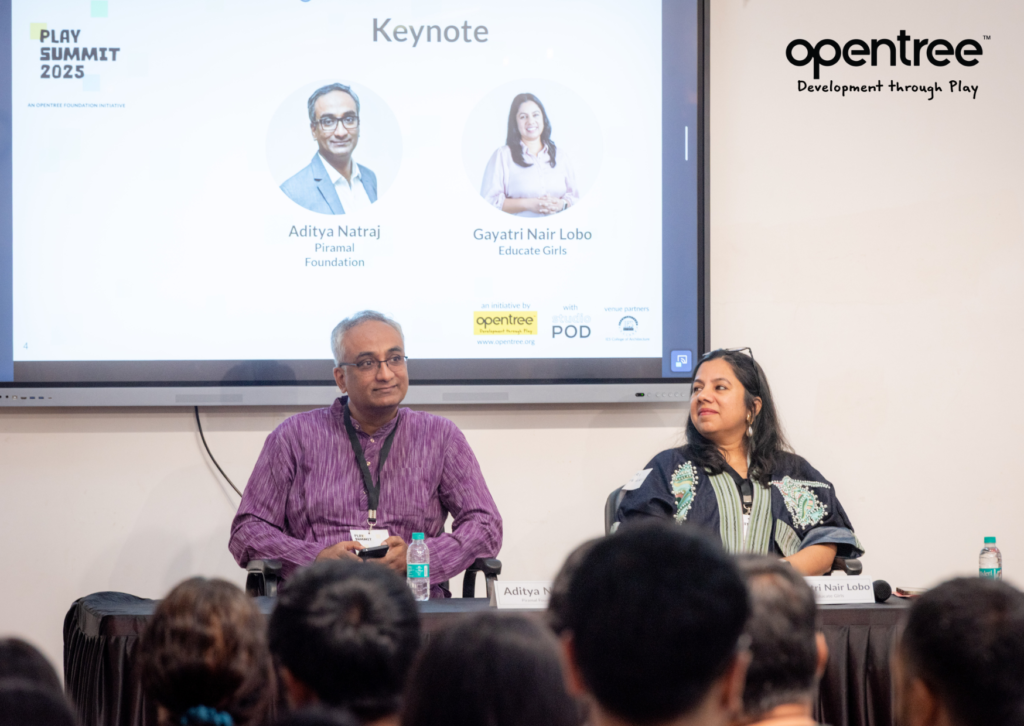
The opening keynotes set the tone. Aditya Natraj, CEO of the Piramal Foundation, reflected on the role Play can play in building learning environments rooted in dignity, leadership, and possibility. Gayatri Nair Lobo, CEO of Educate Girls, the first Indian organisation to receive the 2025 Ramon Magsaysay Award, grounded the conversation in equity, asking what children across contexts truly need to thrive as confident, empathetic human beings.

Together, they positioned Play not as enrichment, but as essential infrastructure.

Alongside the keynotes, we also launched Playpedia.in — TOF’s open-source repository of Play ideas. Co-created by teachers, facilitators, and children across contexts, Playpedia brings together practices rooted in everyday realities, making Play possible and accessible everywhere.

A powerful shift followed when children from TOF’s partner schools in Ahilyanagar and Mumbai took the stage as Play Experts. Speaking from their lived experiences in classrooms, streets, and neighbourhoods, they made one thing clear: children are not passive recipients of design decisions. They are active creators of Play, even when systems make it difficult.

The Summit created space not just to talk about Play, but to practice it.


 Across the day, conversations expanded to explore Play through multiple lenses.

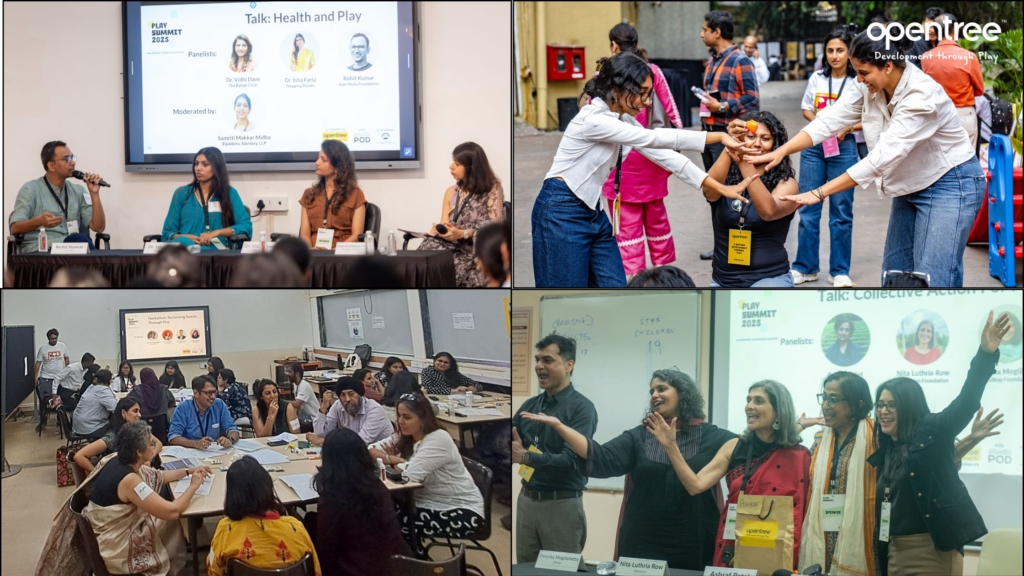
Health & Play examined why Play is central to holistic wellbeing, and how the spaces we inhabit — schools, playgrounds, neighbourhoods — can nurture connection, comfort, and resilience.

Collective Action for Play highlighted the importance of shared vision and collaboration, especially if Play is to become a real priority within India’s development agenda. The message was consistent: change does not happen in isolation, and Play is no different.

Through workshops and hackathons, participants reimagined Play in the everyday — as simple, replicable practices; as everyday spaces redesigned for Playfulness; and as ordinary objects transformed to spark joy, curiosity, and connection, making Play tangible, practical, and grounded in real-world contexts.

Clockwise from top left: Talk: Health & Play, Participants at the Loose Parts workshop, Talk: Collective Action for Play, Participants at the Hackathon on Reclaiming Spaces through Play
Building the Case for Play

A pivotal moment in the day was the launch of Play in Practice, The Opentree Foundation’s latest Play research.

Rooted in over two decades of TOF’s work, the study examines how Play shows up in children’s everyday lives — what enables it, what constrains it, and what this means for how we design systems around children.

For years, one challenge has surfaced again and again in our work: the absence of strong, locally grounded evidence that reflects how Play actually unfolds in Indian realities — and why it matters. Without this evidence, Play continues to be undervalued in policy, planning, and practice.

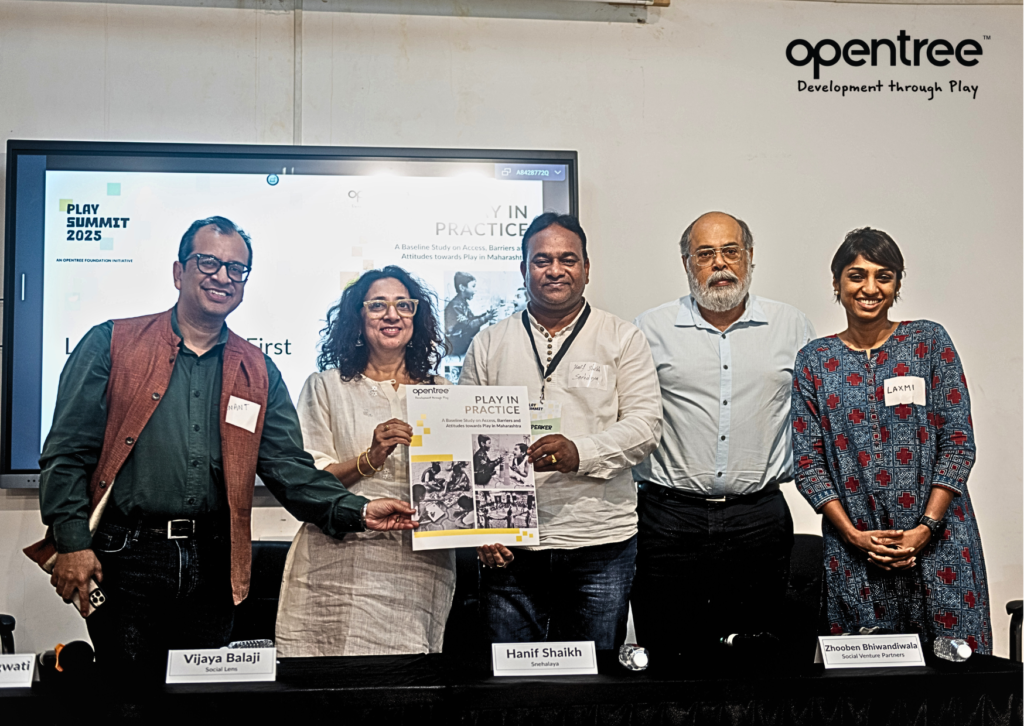
L-R: Anant Bhagwati (Bridgespan), Vijaya Balaji (Social Lens), Hanif Shaikh (Snehalaya), and Zhooben Bhiwandiwala (Social Venture Partners) launch the Play in Practice Research along with Laxmi Nair, Director, Programme Development, TOF

 The research was launched by Vijaya Balaji (Social Lens)Anant Bhagwati (Bridgespan)Hanif Shaikh (Snehalaya), and Zhooben Bhiwandiwala (Social Venture Partners) — leaders who deeply understand both the evidence gap and its implications.

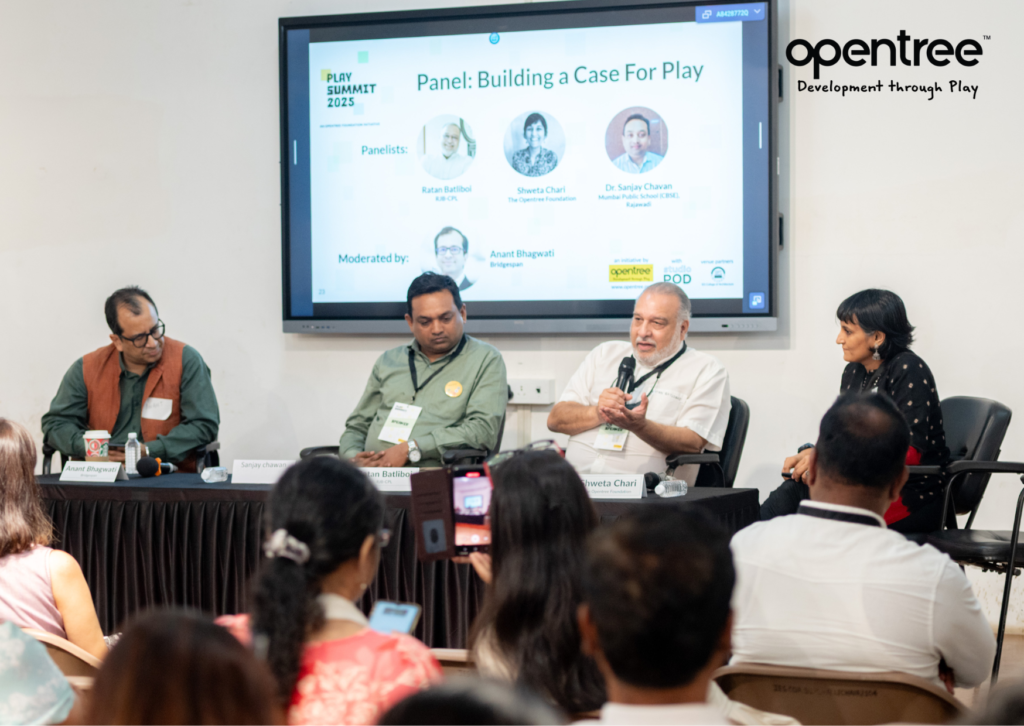
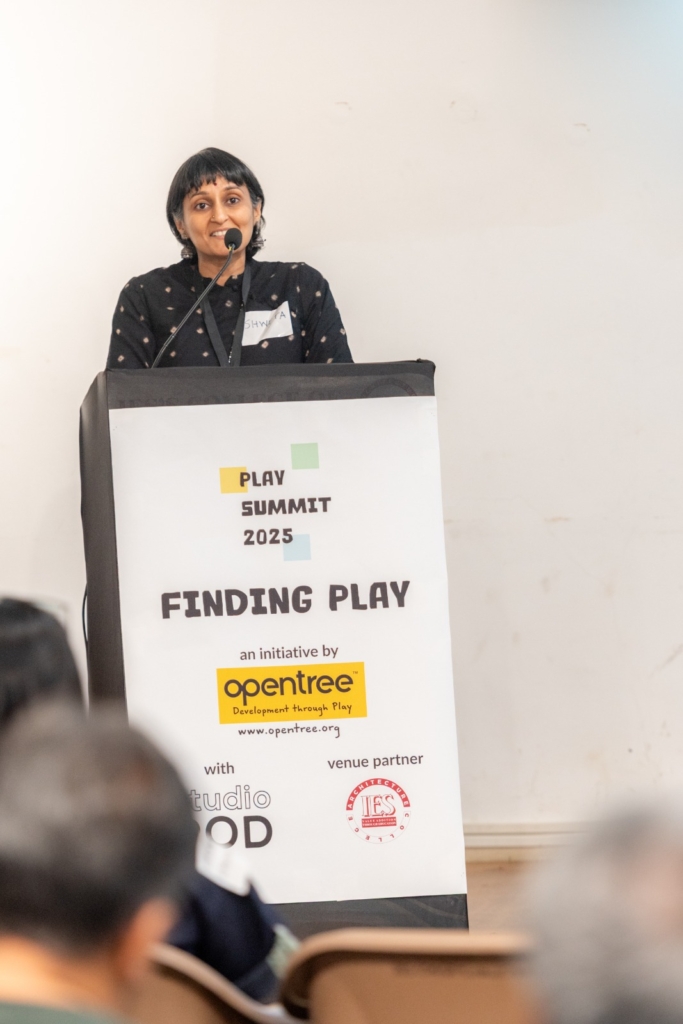
This was followed by a panel discussion, Building a Case for Play, featuring Shweta ChariRatan Batliboi, and Dr. Sanjay Chavan, Principal of Rajawadi MPS School. Each reflected on what transformative Play looks like, and how it can be made accessible within real systems.

L-R: Anant Bhagwati (Bridgespan) moderates a panel 'Building A Case for Play' with Dr. Sanjay Chavan, principal, Rajawadi Mumbai Public School (CBSE), Ratan Batliboi, acclaimed architect, and Shweta Chari, Co-founder & CEO, The Opentree Foundation


Hearing Dr. Chavan speak about the impact of Play on his students, teachers, and school community was a powerful testament to what long-term, trust-based partnerships can make possible.

The panel returned to a central truth: evidence matters, but so do narrative, collaboration, and the courage to challenge long-held assumptions. If Play is to shape the future of childhood and community, it must move from the margins to the centre of how decisions are made.

Experiencing Play and Its Many Possibilities

Alongside these conversations, the Summit was also a space to experience Play in all its richness.

Courtyards filled with blocks, loose parts, and everyday objects became sites of invention and imagination. StudioPOD’s POD Parks invited people to pause, connect, and Play. In the children’s library and Playpedia spaces, stories and games travelled across generations, with adults and children playing side by side.

Exhibits showcased children’s drawings of Play in their schools and cities, alongside designers’ visions of joyful, child-friendly spaces — offering glimpses of what could be possible when Play leads the way.

Finding Play, Designing Forward
TOF's trustee, Devendra Naik (NoMoBo), and advisor Ingrid Srinath (Resource Alliance) brought Play Summit 2025 to a close, with powerful messages for Play to become a collective priority.

The day closed with a guided Play reflection by Devendra Naik, inviting participants to experience Play not as nostalgia, but as something deeply connected to how we learn, connect, and make meaning at any age.

In her closing note, Ingrid Srinath reflected on the day and on TOF’s journey, reminding everyone that sustaining Play requires commitment beyond moments like these.

Play Summit 2025 offered shared language, new relationships, and renewed responsibility — for each of us, as educators, practitioners, funders, policymakers, and caregivers.

Because Play does not survive by accident.
It survives when we choose to design for it.